Sooner than we think
Where AI is taking work, and why waiting to see what happens is the riskiest strategy you’ve got.
I’ve been working with technology for more than 25 years. I’ve seen a lot of hype come and go. Remember when everyone said email was dead because RSS readers were going to replace it? That was around 2005. And every year after that, there was something else that was going to kill it. I built a big part of my career proving them wrong. So trust me when I say I’m not easily impressed by the next shiny thing.
But this time is different.
Over the past year, I’ve built several apps on my own time. A recipe manager. A logistics platform for motorcycle communities. My own macOS dictation app. An app for tracking unpaid invoices. A 50-page website for our motorcycle community. I’m not a developer. I didn’t write the code. I described what I wanted, I pushed back when it wasn’t right, and an AI agent did the building.
A few years ago, I would have needed to hire developers for any one of those. Now it takes a clear idea and a few evenings and weekends.
How work gets done is shifting. And not just for people who write software. I believe for anyone who “works with computers”, as my mom used to say.
So here’s what I believe is coming, and what I think businesses and the people working in them need to do about it.
1. By this time next year, writing code by hand will be a hobby
Let’s start with the most visible change, because it’s moving fastest.
Two years ago, AI was helping developers autocomplete a line here and there. Today, in a growing number of companies, it’s writing most of the new code. In April 2026, Google’s CEO said that 75% of all new code at Google is generated by AI and approved by engineers. In late 2024 that number was about a quarter. In autumn 2025 it was half.
Do you see the curve?
It’s not just Google. In a survey of 705 developers across 60+ countries, 42% said AI now writes half or more of their code. A year earlier, that was 12%.
And then there’s Anthropic, one of the companies building these models. Its AI agents now clock six times as many hours as its employees work. To be fair, about 80% of that agent time is spent waiting for a human to respond. But think about what that tells you. The agents are sitting there, ready to go, waiting on us. The bottleneck isn’t the AI anymore. It’s the humans.

The bottleneck isn’t AI anymore, it’s the humans.
And it’s not just the engineers. Anthropic’s non-technical staff went from about 2 coding sessions with an agent per month to about 90.
So here’s my prediction. By this time next year, the people writing code line by line will be the ones who do it because they love it. The way some people still bake their own bread or restore old motorcycles. Respect to them. But for most business software, paying a human to type out code that an agent can produce in minutes will be very hard to justify.
The developer doesn’t disappear. The job becomes something else: deciding what to build, setting the guardrails, checking the result, and owning the outcome.
What about security?
This is where the story gets more interesting than the headlines.
You’ll hear people say AI code is dangerous. And they have a point. In Veracode’s 2026 benchmark, roughly 44% of the coding tasks it gave AI models produced code with a known security weakness. Its October update showed the first real improvement since it started measuring, with the pass rate climbing to 62%. Better. But that still means more than a third of the tested tasks failed.
But here’s the thing. Human code isn’t safe either. We just badly underestimated how much was slipping through.
In April 2026, Anthropic reported that its AI model Claude Mythos found a security flaw in OpenBSD, one of the most security-obsessed operating systems in the world. That flaw had been sitting there for 27 years. It also found a 16-year-old bug in FFmpeg (software used inside a huge number of video apps) in a line of code that automated test tools had run five million times without catching anything.
So what do we learn from that? It’s not “humans good, AI bad” or the other way around. It’s that no code, human or AI, should be trusted without serious checking. And AI can now do that checking at a speed and scale no human team can match.
That’s where I think we’re heading. Code written by AI, checked by AI, with humans deciding what “good” and “safe” mean and owning the final call. And code that a human wrote and no AI ever reviewed? By end of next year, I believe that will look reckless. The way shipping software without testing it looks reckless today.
2. Every knowledge job will fundamentally change
If you’re not a developer, you might be thinking: “Fine, that’s their problem.” It’s not. Coding is just where it shows up first, because code is easier to test than most other work. You can run it, measure it and check it automatically. Try doing that with a strategy memo.
Everything else is following. Marketing, finance, HR, legal, sales, operations. All of it.
There’s a research group called METR that tracks how long a task AI agents can complete on their own, measured by how long the same task takes a skilled human. Their tests focus on software, machine learning and cybersecurity work. That number used to double about every seven months. Recently it’s been doubling every three to four months. In early 2026, Claude Opus 4.6 succeeded about half the time on tasks that take an expert around 12 hours.
Half the time on 12-hour tasks. Does that sound unimpressive? A few years ago, the same measure was counted in minutes. That’s the curve you should be paying attention to.
And that curve may be getting steeper. In November 2026, METR published an independent assessment of Anthropic’s internal models. Its conclusion: Anthropic is likely improving its models at around twice the pace of the previous year and a half, and roughly 80% of that speed-up comes from AI itself. Read that again. AI is now helping build the next version of AI, faster. That’s why I keep saying: sooner than we think.
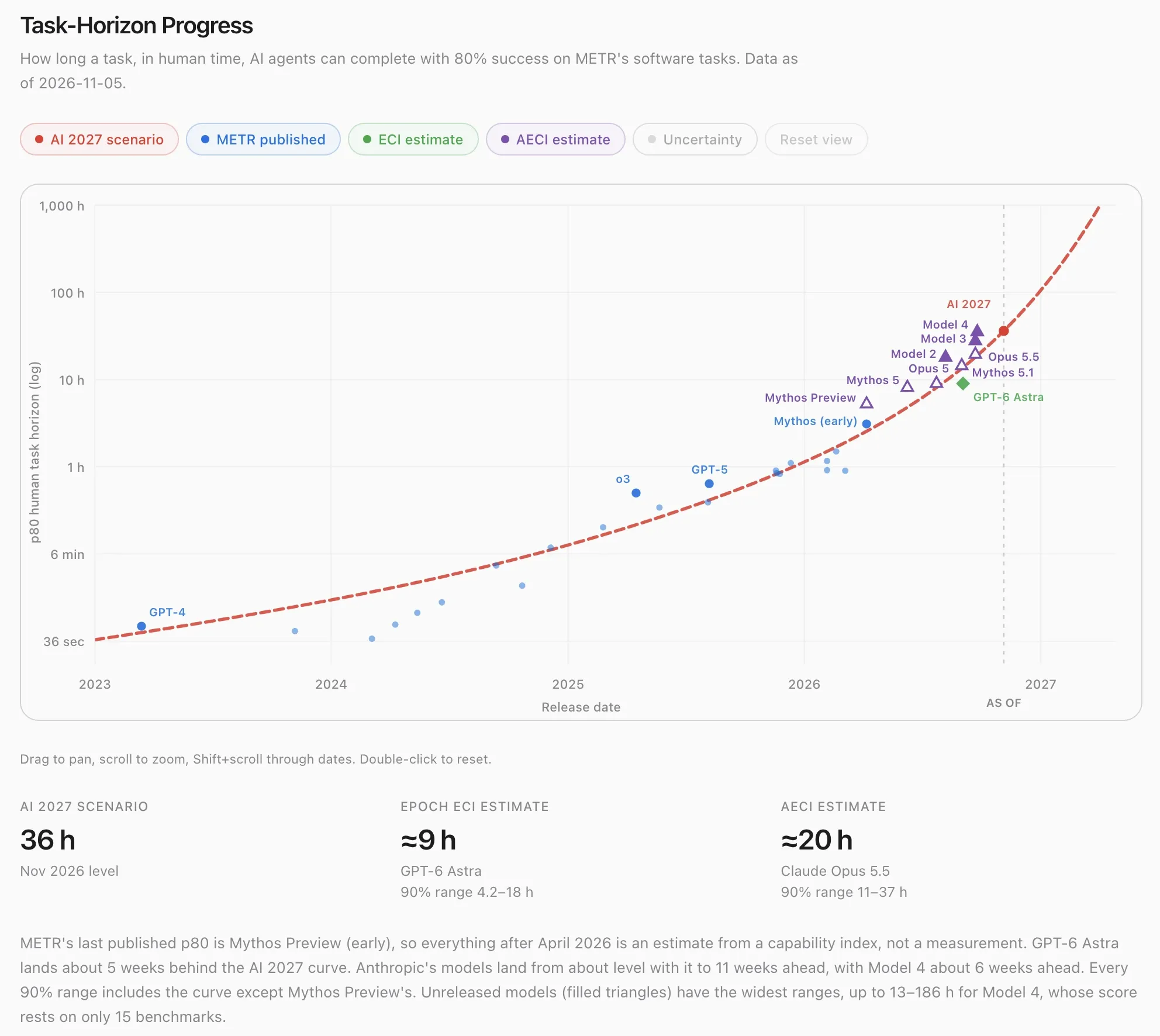
Screenshot from ai2027tracker.com
So what does your job look like when that curve keeps going?
For most knowledge workers, I think it means this: your value moves from doing the work to directing the work. You’ll need to be very, very good at explaining what you want. What’s the goal? What does good look like? What should it absolutely not do? What context does it need to make the right call?
If you’ve ever delegated something to a new colleague and gotten back something completely different from what you had in mind, you know how hard that is. Right? Most of us are honestly not great at it. We assume people know what’s in our heads. Agents don’t. When you leave gaps, they fill them with guesses. And their guesses won’t always be yours.
The companies furthest ahead are already hiring for this. When Anthropic looked at its own hiring, it found managers increasingly focus on candidates’ autonomy and judgment, and less on the execution skills AI is taking over. That’s one company, but it’s the company at the very front of this change. Pay attention to which skills it’s hiring for.
And then we move beyond that
Honestly? I don’t think “being good at giving instructions” is the final stop.
In some workflows, we’re already seeing people write specs for teams of agents, set one agent to review another’s work, and step in only when a decision is needed. At that point, you’re not writing instructions anymore. You’re setting the outcome, the boundaries and the budget, and the system figures out a lot of the rest.
So the skill after “giving clear instructions” is probably something like: knowing which outcomes are worth pursuing in the first place. And having the judgment to spot when a result is wrong, even when it looks perfect.
3. If you want to stay competitive, rebuild. Don’t bolt on.
Here’s what happens in a lot of companies: someone gets access to an AI tool, they use it to write an email a bit faster or summarize a meeting. Everybody feels productive. And the process itself? Exactly the same as it was five years ago.
That’s not transformation. That’s putting a turbo on a bicycle and trying to compete in a Formula 1 race.

The numbers back this up. McKinsey’s 2026 State of AI survey found that almost nine out of ten companies now use AI somewhere. But only about 6% qualify as what McKinsey calls high performers: companies that report significant value and attribute at least 5% of their operating earnings to AI. And one difference jumps out. Nearly three quarters of those high performers have redesigned their workflows around AI. Among everyone else, it’s about a quarter.
Let me repeat that: the companies getting the strongest results aren’t just using more AI. They’re far more likely to have rebuilt how the work gets done.
So what does rebuilding actually mean? It means asking a different question. Not “where can I add AI to this process?” but “if I started this process from scratch today, with agents that can work for hours on their own, what would it look like?”
Very often, the answer is: completely different. Steps disappear. Handovers disappear. Routine checks get automated, while the decisions that need human judgment or accountability stay with people. And the humans in the process end up doing the parts that actually need a human.
That’s hard. It’s a lot harder than buying licenses. But if your competitors pull it off and you don’t, they’ll be faster and cheaper than you. That’s not a risk I’d want to take.
4. So where does that leave us humans?
I’ll be honest with you. I don’t know.
Nobody does. Anyone who tells you exactly how this plays out is selling something.
What I do believe is this: businesses will need far fewer people to run than they do today. I don’t say that lightly, and I don’t say it to scare anyone. I say it because I think we all deserve to hear it straight.
Now, so far the evidence is more subtle than the scary headlines. There’s no mass wave of AI layoffs across the economy yet. The Yale Budget Lab looked at the US labor market in October 2026 and found no clear AI footprint in the measures it tracks. And Harvard Business Review reported earlier this year on companies cutting jobs based on what they expect AI to do, not on work it had already taken over.
But some companies have already made big moves. Salesforce’s CEO said its support team shrank from about 9,000 people to about 5,000 as AI agents took over around half of customer conversations. Block announced it was cutting more than 40% of its workforce, moving to smaller teams built around AI.
Keep in mind: the first sign usually isn’t people getting fired. It’s people not getting hired.
When Anthropic studied its own workforce, it found that the share of junior people among its technical hires fell from 27% to 9%, even as the company kept growing. Its own report put the consequence bluntly: “Employment protections for incumbents will not benefit those not hired to begin with.”
Read that again. All the job protection in the world does nothing for the graduate who never gets that first job.
That’s how I think it will happen in most organizations. It won’t all happen on one dramatic day. It will be a team that doesn’t get a new hire when someone leaves. Or a project that gets done with three people instead of eight. A role that stops making sense because nobody needs it anymore.
If you wait until you feel it, you’ve waited too long.
5. What we owe ourselves
So what do we do with all of this?
I see two responsibilities. One for businesses, one for each of us.
If you run a business
You have a duty to prepare for this future, because it’s going to be here sooner than you’d like. That means being honest with your people about what’s coming, instead of pretending nothing will change. It means investing in rebuilding your processes, not just in buying tools. And it means giving your people the chance to build new skills now, while they can still do it calmly instead of in a panic.
Companies that wait will end up making these decisions anyway. Just later, faster, and with a lot less goodwill.
If you are a knowledge worker
And you have a duty to yourself. Your job is going to change, and parts of it may disappear, faster than you’d like.
Nobody is going to do this for you. Not your manager, not HR, not your company. Some of them will help, and that’s great. But in the end, you’re the one who needs to show up and learn. You owe it to yourself.

So where do you start? Here’s what I’d do if I were you:
- Use AI every single day, on your real work. Not as a gimmick. Not once a week. Every day, on the things you actually get paid to do.
- Hand over one complete task. Pick something you do regularly and let an agent do the whole thing, start to finish. Stick to your company’s rules on confidential data, and check the result before you rely on it. You’ll learn more from where it fails than from where it succeeds.
- Write down how you work. The steps, the decisions, the “it depends” moments. If you can’t explain your process clearly, an agent will struggle to do it, and nobody can redesign it.
- Practice describing outcomes, not tasks. Next time you ask for something, from a person or an AI, start with what “done” looks like.
- Ask yourself the uncomfortable question. Which parts of my job will an agent be able to do a year from now? And what will I be doing instead?
That last one isn’t meant to scare you. It’s meant to get you thinking before someone else makes the decision for you.
One last thing
I know this isn’t the cheerful, everything-will-be-fine kind of message. That’s on purpose.
I’m not writing this because I think AI is bad. I love this stuff. It lets me build things I could never have built on my own. I’m writing it because I’d rather people hear it now than figure it out the hard way later.
The ground is moving. It’s moving fast. And the people and businesses who do well won’t be the ones who saw it coming. Everyone can see it coming.
It’ll be the ones who started moving first.
So, what are you going to change this week?

The views in this article are my personal ones, based on my own experience and observations, about where AI is taking work.
Sources
- Google, Sundar Pichai at Cloud Next 2026
- BairesDev, Q3 2026 Dev Barometer
- Anthropic Institute, How employment is changing at Anthropic, October 2026
- Veracode, 2026 GenAI Code Security Report and October 2026 update
- Anthropic, Project Glasswing, April 2026
- METR, Time horizons and Time Horizon 1.1
- METR, Independent Assessment of AI R&D Acceleration at Anthropic, November 2026
- McKinsey, The State of AI in 2026
- Yale Budget Lab, Tracking the impact of AI on the labor market
- Harvard Business Review, Companies Are Laying Off Workers Because of AI’s Potential, Not Its Performance, January 2026
- Salesforce, Benioff on support headcount
- Block, Q4 2025 shareholder letter